


Why Schools and Small Businesses Are Prime Targets of Ransomware Attacks in 2026 & How to Protect Yourself

If your accountant, school IT coordinator, or operations manager hasn't brought up ransomware lately, that silence is itself a warning sign. Ransomware attacks increased by 34% in 2025, and in just the first ten months of that year, U.S. incidents jumped 50%, with more than 5,000 reported cases. For small businesses, the threat is even more concentrated: ransomware makes up 88% of small business attacks, compared to 39% of large company breaches. If you lead IT decisions at an SMB or educational institution, understanding why you're a prime target and what ransomware protection for small businesses actually looks like in 2026 may be the most important thing you read this year.
Why Small Businesses and Schools Are the Preferred Target of Ransomware attacks
Cybercriminals aren't random. They operate like businesses, optimizing for maximum return with minimum effort. Small businesses face disproportionate ransomware risk because they typically have valuable data but limited security resources. Cybercriminals view SMBs as the target "sweet spot" - companies with enough digital assets to make an attack profitable, but without the dedicated security teams that larger enterprises employ.
Schools face the same math. Like small businesses, schools have become a popular target, and the subject of multiple ransomware attacks thanks to a combination of increased digitization, the robust amount of student and staff data, and a lack of cybersecurity resources. The U.S. had the highest number of education-related ransomware attacks in 2025, with 130 incidents. In one of the most severe recent cases, a 19-year-old pleaded guilty to hacking student information provider PowerSchool for $2.85 million, resulting in the exposure of sensitive data for 10 million teachers and more than 60 million students and more than 100 school systems sued PowerSchool over the breach.
The financial consequences for SMBs are existential, not just painful. A Mastercard survey of over 5,000 SMB owners found that almost one in five who experienced a cyberattack went bankrupt or went out of business. The average downtime following a ransomware attack is 24 days, more than three weeks where you can't access your accounting software, take new orders, or protect customer data.

The Threat Has Evolved: It's Not Just Encryption Anymore
Most articles in this space still describe ransomware as a "lock your files, pay to get them back" problem. That description is dangerously outdated.
Ransomware in 2025–2026 is defined by multi-extortion, AI-enhanced attacks, and a shift toward data theft without encryption. In the double extortion model, attackers pull sensitive data before locking your systems, then threaten to leak it on the dark web if you refuse to pay; even if you can restore everything from backups. This matters enormously for schools and SMBs: a good backup no longer fully protects you. If student records, payroll data, or client contracts are already stolen, the damage happens whether you pay or not.
Ransomware-as-a-Service (RaaS) has democratized cybercrime by allowing novice attackers to purchase ready-made ransomware, meaning thousands of inexperienced criminals can now launch attacks with prepackaged tools. Attackers are also increasingly targeting managed service providers and software vendors to gain access to hundreds of downstream victims simultaneously—a single successful supply chain attack can compromise thousands of organizations.
For schools, this third-party risk is especially acute. "The big distinguishing factor for 2025 is that a lot of the breaches we saw are from these third-party attacks," making it harder for schools because they've not only got to worry about their own systems, but also the third-party systems they're employing.
A Layered Defense That SMBs and Schools Can Actually Build

The good news: you don't need an enterprise security budget. You need a layered approach applied consistently. Here's what works.
Security Awareness Training. Humans remain the weakest link—Verizon found the human element, including phishing and social engineering, contributed to 68% of breaches. Phishing can target high-profile employees more often than others, such as those in human resources, finance, administration, and the superintendent's office—roles with access to sensitive data. Monthly simulated phishing tests cost very little and dramatically reduce click rates over time.
Multi-Factor Authentication (MFA) — Non-negotiable. Implementing MFA is typically the first steps many organizations take to better their security posture. Every email account, remote access point, and admin portal should require a second verification step. No exceptions.
Endpoint Detection and Response (EDR) over basic antivirus. Unlike traditional antivirus—which identifies known malware signatures—EDR monitors device behavior in real time. When a process starts encrypting large numbers of files rapidly, EDR can stop the process, isolate the device, and alert your IT contact before the attack spreads. Small businesses that implement multi-layered ransomware defenses experience 75% fewer attacks compared to those relying on basic antivirus alone.
Network Segmentation. Network segmentation divides your environment so ransomware on one device can't automatically reach every other device and your file server. For most small businesses, practical segmentation means separating guest Wi-Fi from business systems, isolating file servers and backup systems from general user networks, and ensuring workstations can't directly communicate with each other.
Immutable, Air-Gapped Backups. A backup connected to your network is a backup that ransomware can encrypt. Follow the 3-2-1-1-0 rule: three copies of data, on two media types, one offsite, one air-gapped (offline), and zero unverified backups. Uvalde, Texas school district avoided paying a ransom by restoring their systems using backups after a ransomware attack. That outcome is only possible if backups exist, are current, and are untouched by the attack.
The Gap Most Missed: Your Incident Response Plan Needs to Be Tested
Most cybersecurity content stops at prevention. The harder, and more important truth is that prevention alone is insufficient: you also need a practiced response.
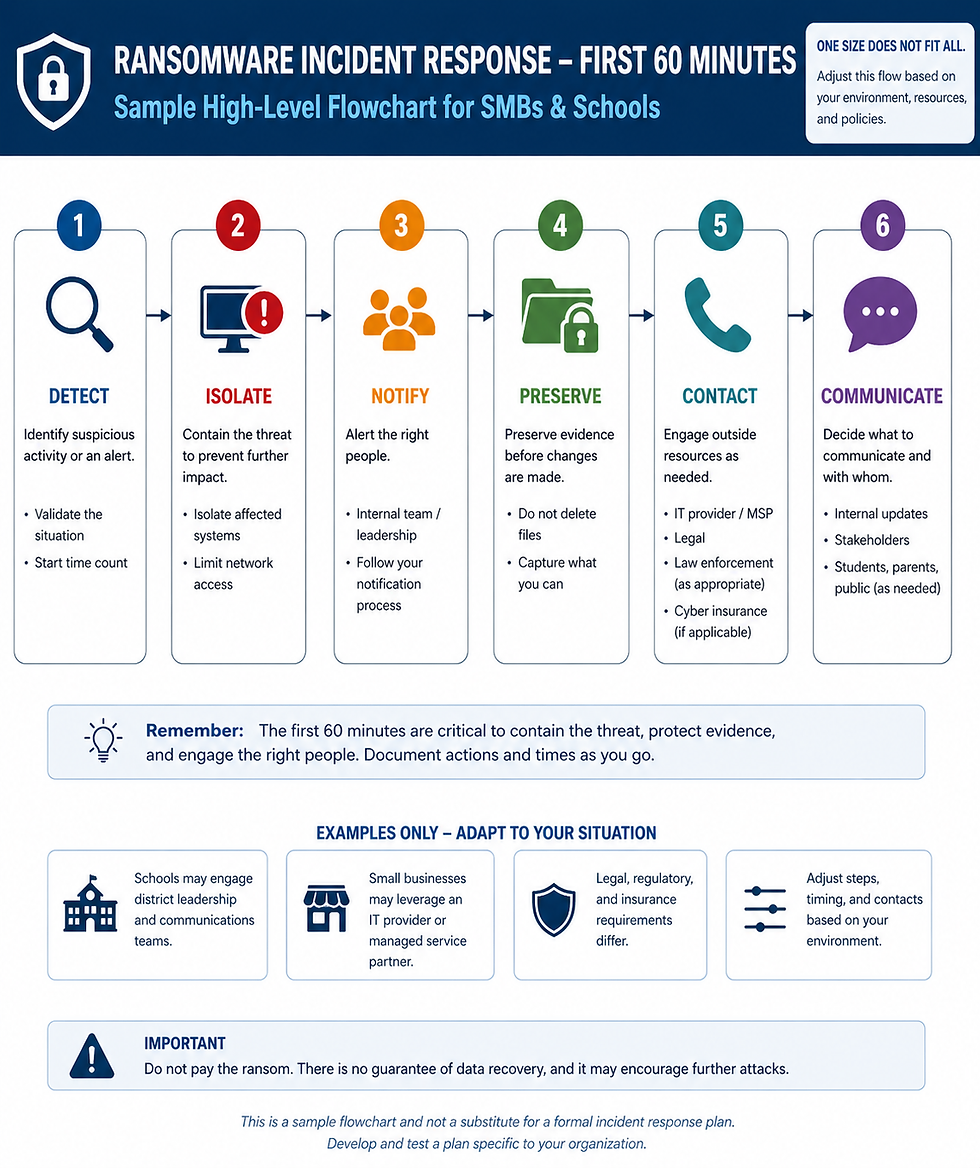
98% of businesses have a ransomware attack response playbook, but more than half have playbooks that lack essential features like a pre-defined chain of command. A plan that exists only in a document is not a plan. When ransomware hits at 2 a.m. on a Friday, the people in your building need to know exactly what to do in the first 15 minutes—who to call, which systems to isolate, whether to shut down or contain, and when to involve law enforcement.
Your incident response plan should answer these specific questions:
Who is the decision-maker when key personnel are unavailable?
Which systems get isolated first—and how?
What is your communication protocol for staff, parents, customers, and regulators?
Who are your external contacts—cyber insurance carrier, legal counsel, forensics vendor, FBI?
"A worst-case scenario plan should also be in place because, as cyber criminals continue to exploit vulnerabilities via third parties, even schools and businesses with the best cybersecurity standards can be left vulnerable when the third parties they're working with are targeted."
Tabletop exercises, simulated attack walkthroughs, should be regularly scheduled, and are the single best way to find gaps before attackers do. They require no special technology, just dedicated time and the right facilitator.
The core message is this: ransomware in 2026 is faster, smarter, and structurally designed to exploit the exact gaps that small businesses and schools have. But it is not unstoppable. Organizations that combine layered technical controls with a tested human response plan are dramatically harder to compromise, and dramatically faster to recover when something does get through.
How 24ITintegrator Can Help
The challenges covered in this article: outdated endpoint protection, unverified backups, missing incident response plans, and third-party vendor risk, are exactly where 24ITintegrator's Information Security consulting services focus. We work directly with small and medium businesses and educational institutions to assess their current exposure, implement layered defenses scaled to realistic budgets, and build response plans that your team can actually execute under pressure. A conversation with our team is the right next step. Reach out to 24ITintegrator to schedule a security assessment before an attacker makes that decision for you.


